On March 17, 2019, a 16-inch water main broke on Rancho Hills Drive in Chino Hills, buckling the street in several places and sending water down nearby streets. Residents were told to shelter in place, and it was unclear whether any homes flooded. The event is a reminder of how fast water leaves a broken main, and how much depends on where it goes next.
Key takeaways
- The March 17, 2019 break involved a 16-inch main south of Grand Avenue and west of the 71 Freeway, and it ran for about two hours.
- It was unclear whether any homes flooded that day, so street water and house water are two different problems.
- Water from a broken main starts out clean, but it picks up dirt as it crosses pavement, soil and a garage floor.
- The City of Chino Hills provides water and sewer service on one bill, so a break in the street is reported to the city.
- Inside a home the order is extraction first, then removal of soaked materials, then structural drying with daily readings.
What happened on Rancho Hills Drive in 2019
On March 17, 2019, a 16-inch water main broke on Rancho Hills Drive, south of Grand Avenue and west of the 71 Freeway. The street buckled in several places.
The break ran for about two hours and filled several streets with water. Residents were told to shelter in place.
Reports left it unclear whether any homes flooded. Nothing here claims a home was damaged that day.
The event matters for what it shows. One pipe can put water into a neighborhood faster than anyone can react.
A main break is a utility event, not a household one. The pipe, the valve and the street belong to the public system, while the water that crosses a threshold becomes the household's problem to dry.
How street water gets into a house
Water from a street does not need a flood to cause damage. It only needs a path.
Chino Hills covers about 44.8 square miles, much of it rolling hills, so a house can sit above or below its street. How a house sits against the street decides which way the water runs.
- A driveway that slopes toward the garage door
- A garage door seal that has worn or lifted
- A low door threshold or a sliding door track
- A gap where a pipe or cable enters a wall
- A low patio that drains toward the house
What to do when the water is at the door
These steps keep people safe and the record clear. They do not stop a main that is still running, which is a utility matter.
If the water has stopped but the garage floor is still wet, the job is not over. Standing water left in place soaks into stored boxes and wicks into the shared wall.
- Stay out of standing water near outlets, cords and the garage opener.
- Turn off power to the wet area at the breaker only if the panel is dry and easy to reach.
- Move cars, stored boxes and rugs to higher ground.
- Report the break to the City of Chino Hills, which provides the water service.
- Photograph the water, the doorway and the street, with the date.
- Keep children and pets out until the area has been checked.
Water from a main versus water from inside the house
Where the water starts changes how it is handled.
Clean source, dirty path
A main carries treated water, so the source is clean. The path is not.
Water that crosses pavement, soil and a garage floor carries dirt and whatever it touched. It is handled with more care than water from a household supply pipe.
Source inside the walls
A supply pipe that bursts inside a wall releases clean water that stays in the structure. The cleanup centers on cavities and the subfloor.
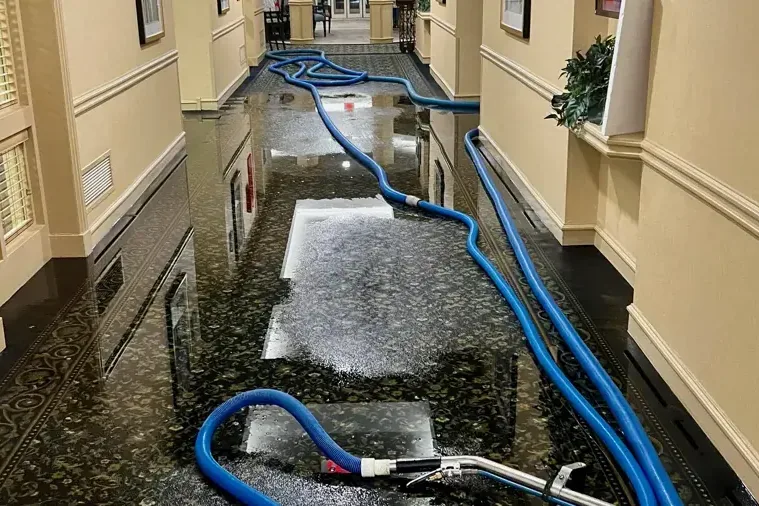
The first step is the same either way: water extraction pulls out the standing water before it soaks further.
Extraction, removal and drying
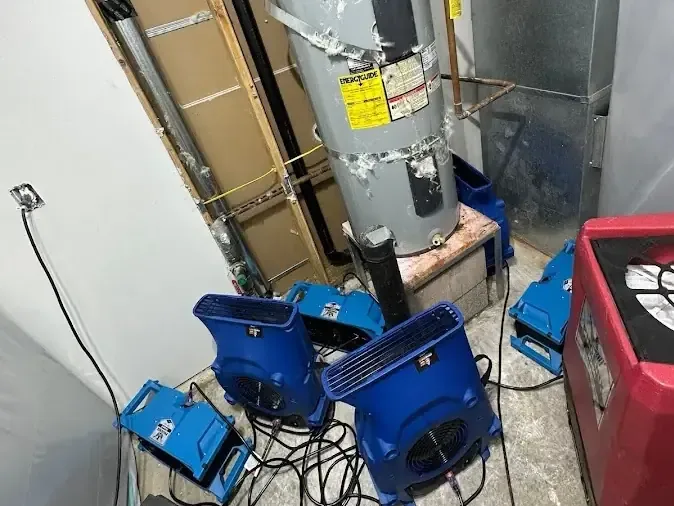
After the water is out, the crew reads moisture in walls and floors to find where it went. Materials that took on dirty water are removed, and what remains is dried in stages.
That second half is structural drying, with readings every day until the structure matches a dry reference.
Moisture readings are the only reliable way to know a wall is dry. A wall can look and feel dry on the surface while the bottom plate and the insulation behind it stay wet.
- Standing water is pumped and vacuumed out first.
- Carpet pad, baseboards and low drywall that took on dirty water are removed.
- Hard surfaces are cleaned and dried.
- Air movers and dehumidifiers run while readings are logged.
- Stored items are sorted into those that can be cleaned and those that cannot.
One city utility, one bill
The City of Chino Hills provides both water and sewer service, and residents see them together on one bill. That makes the city the place to report a break in the public system.
A sewage problem inside a home is a different matter and is cleaned as Category 3 water. Local detail on both kinds of work is on the water damage pages for the city, and the general method is described under water extraction and removal.
Records worth keeping
Coverage for water that comes from outside a home depends on the policy and the cause. Good records make the conversation with an insurer simpler.
A simple habit helps: take photos before moving anything, then again after the water is out. The pair shows what the water did and what the cleanup changed.
- Dated photos of the water, the doorway and the damaged items
- A list of what was wet, with approximate values
- Moisture readings and the drying log from the crew
- Notes on when the break was reported and to whom
Questions
Who should be told about a water main break?
The City of Chino Hills provides the water service, so the break is reported to the city. Water inside a house is cleaned up separately from the repair in the street.
Does the March 2019 break mean homes in the city flood?
No. It was unclear whether any homes flooded that day, and one event does not set a pattern. It is used here to show how quickly street water spreads.
Is water from a broken main safe to touch?
Treat it with care. The water leaves the pipe clean, but it picks up dirt and chemicals from the ground and garage floors. Wear boots and gloves, and keep out of water near electrical outlets.
Can wet drywall be saved after street water?
Sometimes. Drywall that was wet briefly with clean water can dry in place, while drywall that sat in dirty water is usually removed. Moisture readings make the call.
What if the garage floor is wet but the house is dry?
Dry the garage floor and check the shared wall and the door threshold, because water can wick sideways into the house. A few readings can confirm the wall is dry.
Is a concrete garage floor hard to dry?
A concrete floor dries slowly because it holds water. Extraction is followed by air movement and dehumidification, and readings show when the floor is dry.