Structural Drying and Dehumidification in Walnut, CA
After the water is extracted, the drying team sets air movers and LGR dehumidifiers for the class of loss and logs readings every day until framing, subfloor and slab match a dry reference, 24/7.
(888) 563-9619Need readings, not guesses? Start the drying plan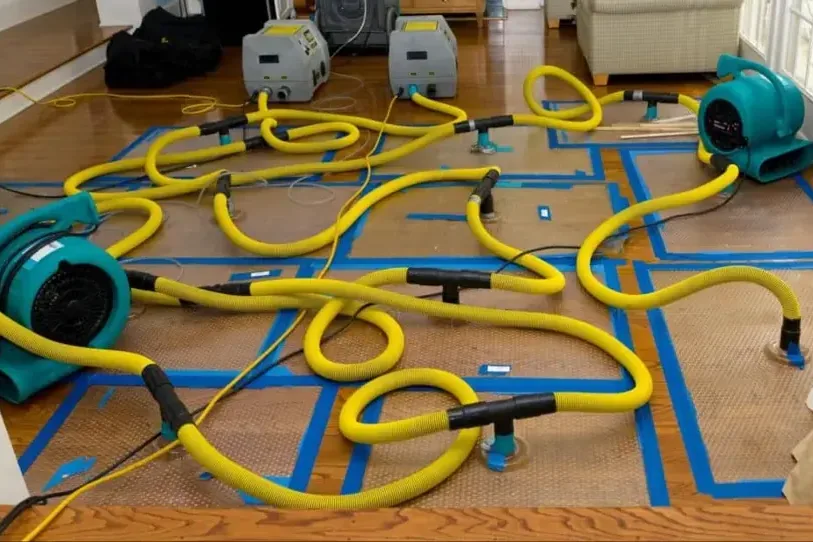
What every structural drying and dehumidification job includes
Extraction comes first
Truck-mounted and portable extractors pull free water before any fan goes down, since lifting liquid water out is far faster than evaporating it.
Dried to IICRC S500
Air movers and LGR dehumidifiers are sized to the class of loss, and the equipment stays until readings sit within 2 to 4 points of a dry reference.
A claim file built on site
Moisture maps, daily psychrometric logs and timestamped photos taken before any demolition give the adjuster a clear record of the loss.
Valley houses, valley habits
Slab floors with copper underneath, attic air handlers and large floor plans decide where water hides, so the walkthrough checks each one.
What to do right now about structural drying and dehumidification
- Extract first. Free water must be removed before drying starts.
- Keep the room closed. Doors and windows shut so dehumidifiers work.
- Leave equipment running. Turning it off at night stalls the drying.
- Keep clear of cords. Air movers and cords stay where they are set.
What does structural drying and dehumidification cost in Walnut, CA?
Structural drying is priced mostly by equipment days and the size of the wet area. Most jobs fall between $500 for a small clean-water area and $25,000 for sewage or a whole floor, with slab and hardwood running longer.
Small clean-water loss
- One room or a closet
- Extraction and drying in place
- Category 1 water caught early
Room-sized or slab leak
- Several rooms or flooring lifted
- Baseboards and lower drywall opened
- Category 1 or 2 water
Whole floor or sewage
- Category 3 water or runoff
- Porous materials removed
- Containment and antimicrobial
What the claim file holds
Ranges are typical, not a quote: the water category, square footage, material class and how fast drying started move the number most. Sudden and accidental water from a pipe, appliance or tank is often covered by a homeowner policy, while surface flooding usually needs a separate flood policy, so check your own policy.
The mitigation team builds the file an adjuster reads: a moisture map, daily psychrometric logs, timestamped photos taken before demolition, the category and class, and a line-item scope. For a closer range, run the water damage cost calculator.
How structural drying and dehumidification is handled, step by step
Set the dry goal
Reference reading from dry material.
Size the equipment
Air movers and LGR units by class.
Log every day
Temperature, humidity, grains, readings.
Verify dry
Equipment out on the numbers.
Water that soaks into drywall, framing, subfloor and slab does not leave when the floor looks dry. Structural drying in Walnut homes pulls that hidden moisture out on purpose, with equipment sized to the job and readings that decide when it is done.
Class of loss sets the equipment
The IICRC S500 standard sorts losses into Class 1 to 4 by how much water the materials absorbed. Class 1 is a small, mostly surface loss; Class 4 means dense materials such as hardwood, plaster or a concrete slab that need low-grain or desiccant dehumidifiers and more time. The class sets how many air movers and dehumidifiers each room gets.
What the daily logs record
Each visit records temperature, relative humidity and grains per pound inside and outside the drying area, plus material readings at marked points. If a reading stalls, equipment is moved or added. Those psychrometric logs go into the claim file with the moisture map and photos.
When the job counts as dry
Equipment comes out when wet materials read within 2 to 4 points of a dry reference material in the same home, not when they feel dry. Hardwood and slab, common after a slab leak, take the longest. Extraction always comes first, as described on the water extraction page.
Structural drying and dehumidification across Walnut and the east San Gabriel Valley
The restoration team covers ZIP 91788 and 91789, from Snow Creek, Three Oaks and Country Hollow below the San Jose Hills down to Lemon Creek, Creekside and the homes along Valley Boulevard.
Nearby coverage reaches Diamond Bar, West Covina, Pomona, Rowland Heights, City of Industry, La Puente, San Dimas, Covina.
Related water damage services
Structural Drying and Dehumidification questions, answered
Still dealing with it?
Floors feel dry but the walls still read wet? Readings, not touch, decide when drying is done.
(888) 563-9619 Ask how dry gets verifiedWhy does structural drying take several days?
Water soaks into drywall, framing and slab, and it can only leave as fast as evaporation and dehumidification allow. Most Class 1 and 2 losses dry in three to five days; slab and hardwood take longer.
Can I turn the drying equipment off at night?
It is best to leave it running. Turning air movers and dehumidifiers off lets humidity climb back up, which stalls drying and adds days.
What is an LGR dehumidifier?
A low grain refrigerant dehumidifier pulls water out of the air even when the air is already fairly dry, which keeps wet materials releasing moisture through the end of the job.
How is dry measured?
Moisture meters compare wet materials with a dry reference of the same material in an unaffected room. The goal is within 2 to 4 points of that reference.
Why are baseboards removed during structural drying?
Pulling baseboards lets air reach the bottom of the drywall and the wall cavity, so the wall can dry without cutting out large sections.
Hidden moisture keeps working after the floor looks dry
The drying team sizes equipment to the class of loss and logs readings every day until the structure is dry, any hour.
(888) 563-9619Set up drying and daily logs