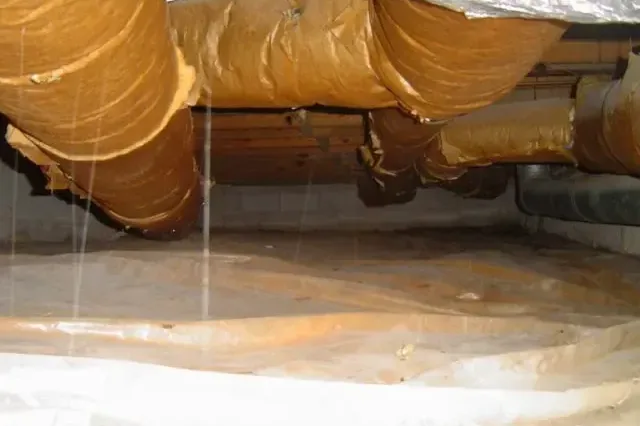
Pomona summers run long and hot. July highs average 90.3 degrees F, August highs average 92.4 and the record sits at 117, so air conditioners work for months at a stretch. All that cooling pulls water out of the air, and the water has to go somewhere.
Key takeaways
- An air conditioner pulls moisture out of indoor air, and that condensate leaves through a small drain that can clog.
- When the drain clogs, the pan under an attic or closet air handler fills and overflows onto the ceiling below.
- Warning signs are a faint stain on a hallway ceiling, a wet closet floor or a pan holding standing water.
- Turning the system off stops the water. Clearing the drain and drying the ceiling are separate jobs.
- A slow drip over weeks soaks insulation and drywall more than one big spill, so small stains deserve attention.
Why condensate drains clog and pans overflow
Cooling air makes water form on the coil inside the air handler. The water drips into a pan and leaves through a small drain pipe.
That pipe is narrow and damp, which makes it a good place for slime, dust and debris to collect.
Once the pipe clogs, the pan fills and the extra water spills over the edge, onto the ceiling below or the floor of a closet.
Attic units are the usual trouble spot. The drain runs through a hot, dusty space and out of sight, so nobody sees a slow clog building.
- Slime and algae growing inside the drain pipe
- A drain pipe that sags and holds water in a low spot
- A pan that has cracked or rusted through
- A safety switch that failed or was never installed
- A frozen coil that melts into the pan faster than it can drain
Why the hot months are the risky months
Pomona has a Mediterranean climate, with hot, dry summers and a lot of sunshine. Almost no rain falls from June through September, with 0.06 inches in June and 0.00 in July.
That means a stain in the middle of summer rarely comes from the roof. When the ceiling gets wet in a dry month, the air conditioner is one of the first things to check.
A system that runs for months also gives a clogged drain months to overflow. A pan that was fine in May can be full by August.
Warning signs inside the house and at the unit
The signs show in two places, and checking both separates condensate from a roof leak.
Because condensate drips slowly, a stain is often pale at first and darker later. A stain that returns after painting is a classic sign that the source was never fixed.
Inside living space
A tan stain on a hallway or bedroom ceiling that grows while the system runs, even on dry days, points to condensate.
- Stains, bubbling paint or a damp smell near the air handler
- A soft or sagging patch of ceiling drywall
- A wet floor in a closet that holds the unit
At the air handler
A pan with standing water, rust on the pan or the platform, and drips at the base of the unit all show that the drain is not keeping up.
First steps when the drip starts
Switching the system off stops new water. It does not dry what is already wet, so AC condensate cleanup follows the shutoff.
A technician can clear the drain with a wet vacuum, compressed air or a flush. Pouring chemicals into a drain pipe without knowing what it is made of can damage it.
- Turn the air conditioner off at the thermostat and then at the breaker.
- Move belongings out from under the stain and set a bucket under any drip.
- Look at the pan only if the space is safe to enter, and note whether it holds water.
- Photograph the stain, the pan and the date.
- Keep the system off until a technician has cleared the drain.
When the ceiling is already sagging
A ceiling that bows is holding water. Keep people out from under it and turn off power to the fixtures in that area.
A restoration crew opens a bowed section in a controlled way, so the water goes into containers instead of onto furniture and floors.
Wet drywall is heavy. When a sagging ceiling finally lets go, it can bring wet insulation down with it.
- Do not stand or sit under the bulge.
- Do not poke or cut the ceiling with a tool.
- Turn off the breaker for lights and fans in that room.
- Leave the opening to a crew that can contain the water.
How the wet ceiling and closet are dried
A slow condensate drip often runs for weeks before anyone sees a stain, so the insulation above the ceiling is usually the wettest layer. A ceiling leak water damage job starts there.
Moisture readings decide how much material comes out and how long the equipment runs.
Insulation that has been wet for weeks stays wet. It sits against the drywall like a sponge, and drying it in place is rarely practical.
- Wet insulation is removed and bagged.
- Saturated drywall is cut out and the framing is exposed.
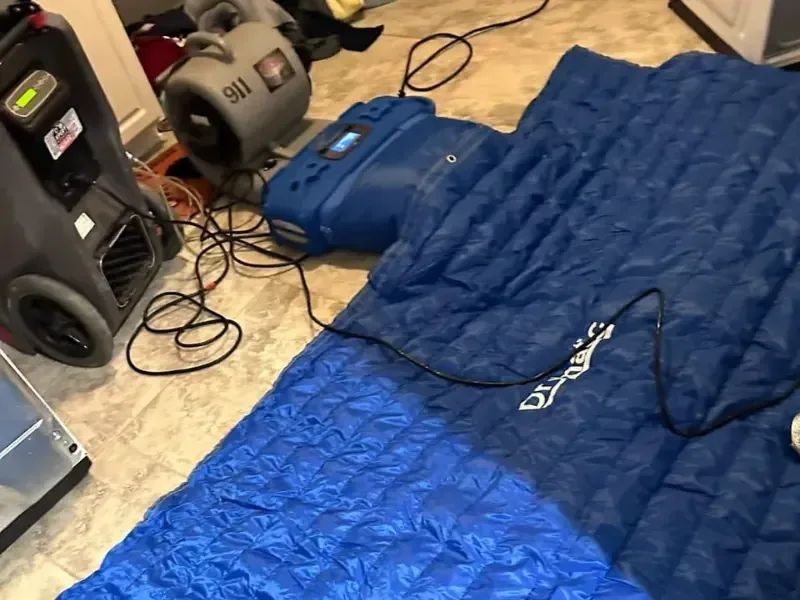
- Air movers and dehumidifiers dry the ceiling bay and the closet.
- Readings are logged daily until the materials are dry.
Keeping the drain clear through the hot months
Because the system runs so many months, a few habits cut the risk. More detail on the local work is on the Pomona water damage pages, and the same steps appear under AC condensate overflow cleanup.
Tenants who cannot reach the unit can still watch ceilings and closets, and report the first stain to the owner.
- Have the drain pipe flushed or cleared before the cooling season starts.
- Check the pan now and then for standing water.
- Ask a technician about a float switch that shuts the system off when the pan fills.
- Replace the air filter on schedule.
- Do not paint over a stain until the source is fixed and the ceiling is dry.
Questions
How can a homeowner tell condensate from a roof leak?
Condensate stains appear below an air handler and grow while the system runs, even on dry days. Roof leak stains grow during or after rain.
Is condensate water clean?
It starts out as clean water, but it can pick up algae and dust from the pan. Insulation that stayed wet for weeks is removed rather than dried.
Can a small stain be left alone?
A small stain can mean a slow drip that keeps going. Check the pan and the drain, and watch whether the stain grows.
Does insurance cover an air conditioner overflow?
It depends on the policy and on whether the damage was sudden. Keep photos and any technician's findings, and ask the insurer.
Why does a stain come back after the ceiling is painted?
Paint over a wet ceiling traps moisture. The source and the wet insulation have to be dealt with first.
Does a clogged drain mean the whole system is failing?
Not usually. A clogged drain is a maintenance problem and the system itself can be fine. It still needs to be cleared before the system runs again, or the pan will fill once more.