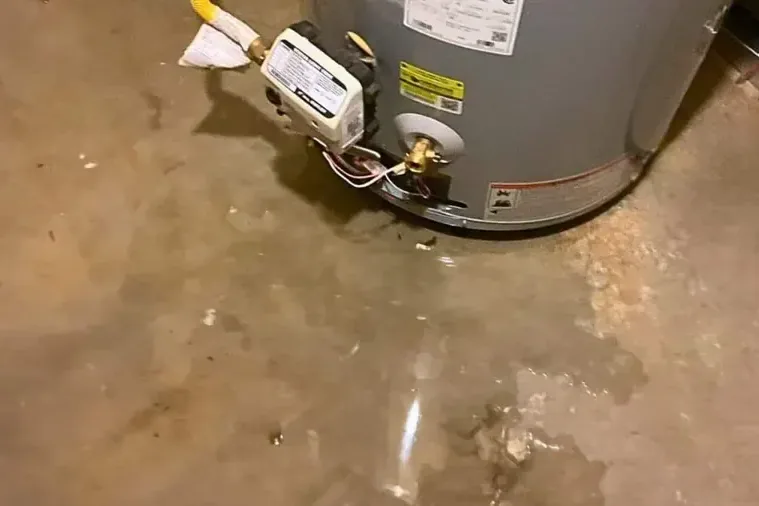
About 94.7 percent of homes here are single-family, and about half are four-bedroom houses. A leaking water heater in a house that size has plenty of floor to cross and plenty of walls to soak before anyone notices.
Key takeaways
- A failing tank can empty a full load of water onto the floor and into the walls around it.
- Closing the cold water valve and shutting off power or gas stops the refill, but it does not remove the water already loose.
- Where the tank sits, in a closet, a garage or a utility room, decides where the water goes next.
- Water that gets under a wall and into hallways or bedrooms is the costly part, so extraction should start fast.
- Homes built from 1970 to 1999 make up 74.7 percent of the housing here, so connections around the tank have often been in service for years.
Why a bigger house changes the cleanup
In a small home, a leaking tank may reach only a closet and a hallway. In a larger house, the water has more floor to cross and more walls to wick into.
A utility closet in a four-bedroom house often sits near bedrooms, a laundry room and a family room. Water that leaves the closet can head toward any of them.
Because housing here is almost all single-family, a leak stays inside one home, and the household that finds it is the one that has to act fast. A water heater leak cleanup starts with the same few moves each time.
Carpeted bedrooms near the tank take up water quickly, and the pad beneath holds it long after the surface feels dry.
Signs a tank is close to failing
Tanks rarely fail without warning, but the warning is easy to miss in a closet or a garage corner.
A quick look every few months catches most of it.
- Rust colored streaks at the base of the tank or around the fittings on top
- A relief valve that drips or leaves a stain on the floor
- Rumbling or popping while the water heats
- Water that looks rusty when the hot tap first opens
- A puddle that appears, dries and appears again
The first steps when the tank lets go
These steps stop new water. They do not remove what is already on the floor.
A leak from a fitting on top can often be slowed by closing the cold water valve alone. A leak from the body of the tank cannot, because the tank is already full and has to drain.
- Turn off the power or the gas control to the heater so it does not run on a leaking tank.
- Close the cold water valve at the top of the tank.
- Keep people and pets out of the wet area. Wet floors are slippery and outlets may be nearby.
- Photograph the tank, its label and every wet surface.
- Lift rugs, boxes and small furniture off the floor.
Where the water goes from a closet, a garage or a utility room
The location of the tank tells a crew where to look first.
Water also follows pipe openings. A pipe that passes through a wall or floor gives it a path into the cavity behind it, so a crew checks around those openings and under every door threshold.
Closet tanks
A tank in a closet sits against walls. Water soaks the baseboards and the bottom of the drywall, then moves under the wall into hallways and bedrooms.
Garage tanks
A garage tank sends water across the floor toward the door and toward any shared wall with the house. Stored cardboard boxes soak up water from the bottom and fail quickly.
Utility room tanks
A utility room tank wets cabinets, laundry flooring and anything stacked nearby. A washer and a tank often share that space, so both are checked for the source.
What gets removed and dried
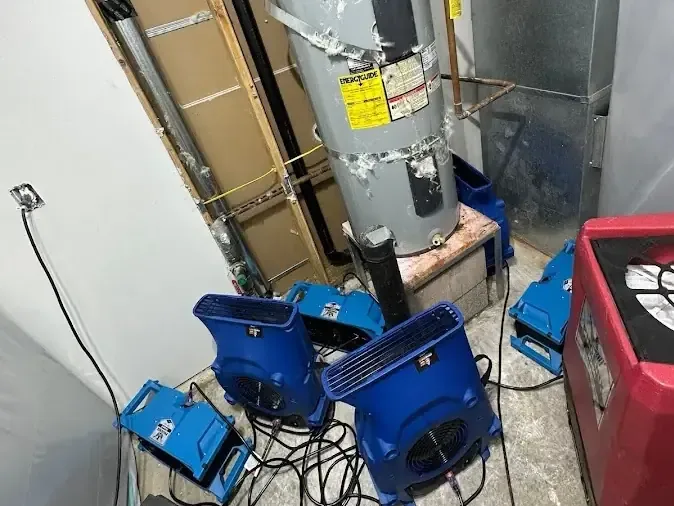
The first job is to pull standing water with pumps and wet vacuums, as described under water extraction. The crew then reads moisture in walls and floors to see where the water actually went.
Moisture mapping marks every wet surface with a reading. The readings repeat each day, and the map shrinks until it is gone.
That record is also useful for an insurance claim.
- Carpet pad is usually replaced. Carpet may dry in place when extraction starts quickly and the water was clean.
- Baseboards are pulled so the wall bottoms can dry.
- Drywall that stayed wet is cut out and replaced rather than dried.
- Wet insulation behind a closet wall is removed.
- Flooring is lifted where the subfloor stays wet.
Tank age and what comes after the cleanup
Tanks fail from the inside. The lining wears, sediment builds up and a seam or fitting finally opens.
A leaking tank is replaced, not patched.
Homes built between 1970 and 1999 make up most of the housing here, so it is worth checking the age marked on the label of any tank. The same shutoff habits apply to washer hoses and dishwasher supplies, covered under appliance leak water damage.
Drying the structure and keeping records
Equipment is placed so air moves across wet surfaces while the dehumidifier pulls moisture out of the room. Doors to dry rooms stay closed, so the drying stays focused on the wet area.
Drying a wet closet and hallway follows measured steps, set out under structural drying. Readings are taken each day until they match a dry reference.
Insurance treatment of a tank leak depends on the policy, and some policies handle the water damage and the replacement tank separately.
- Photos of the label, the leak and the wet areas
- The plumber's invoice and written findings
- Daily moisture readings from the drying crew
Questions
Can a water heater leak be fixed without replacing the tank?
A leaking tank is replaced. A leak from a fitting, valve or supply connection can sometimes be repaired by a plumber, so the first step is finding where the water comes from.
Is a small puddle around the tank an emergency?
A small puddle can be an early warning. If it grows, if rust shows on the tank or if the floor feels soft, shut off the supply and have the tank checked.
How far can water spread from a leaking tank?
Far enough to wet walls and floors in nearby rooms. In a large house it can run under walls into hallways and bedrooms.
Does homeowners insurance pay for a water heater leak?
It depends on the policy and the cause. Many policies cover sudden water damage, while the tank itself may be treated differently. Check the wording or ask the insurer.
Do wet carpets always have to be removed?
Not always. Clean water from a tank can sometimes be dried out of carpet when extraction starts quickly, while the pad underneath is often replaced.
Should the tank stay off until a plumber replaces it?
Yes. A leaking tank should stay shut off until a plumber replaces it or confirms that the leak came from a fitting. Drying can go on while the plumber works.