Structural Drying and Dehumidification in Montclair
After standing water is removed, walls, floors and framing are dried with air movers and dehumidifiers, and measured moisture readings show when each material has reached normal levels before anything is rebuilt.
(888) 563-9619Request a drying plan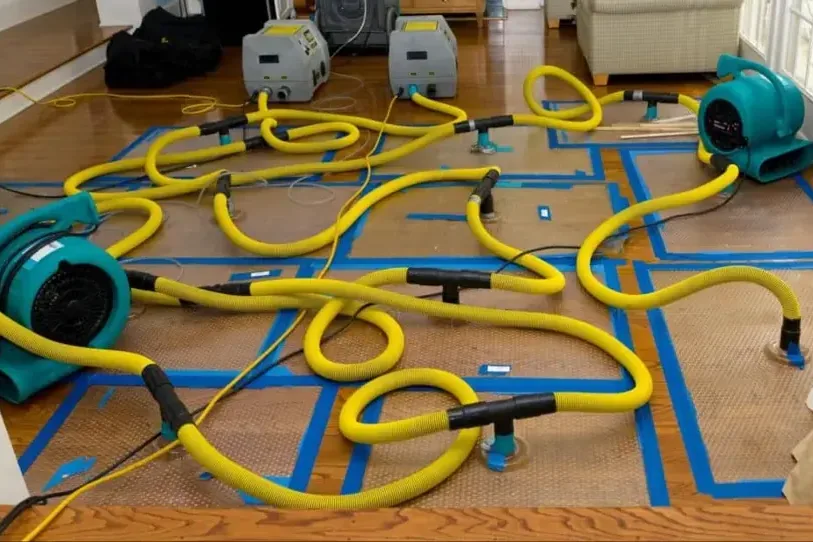
What every structural drying and dehumidification job includes
Extraction comes first
Truck-mounted and portable extractors pull free water before any fan goes down, since lifting liquid water out is far faster than evaporating it.
Dried to IICRC S500
Air movers and LGR dehumidifiers are sized to the class of loss, and the equipment stays until readings sit within 2 to 4 points of a dry reference.
A claim file built on site
Moisture maps, daily psychrometric logs and timestamped photos taken before any demolition give the adjuster a clear record of the loss.
Valley houses, valley habits
Slab floors with copper underneath, attic air handlers and large floor plans decide where water hides, so the walkthrough checks each one.
What to do right now about structural drying and dehumidification
- Extract first. Standing water is removed before any equipment is set.
- Map the moisture. Meters read walls, floors and framing room by room.
- Place the equipment. Air movers and dehumidifiers go where the readings point.
- Check and adjust. Readings are logged at each visit until normal.
What does structural drying and dehumidification cost in Montclair, CA?
Structural drying in Montclair costs $500 to $2,000 for a small clean water loss, $2,500 to $7,500 for a room sized or slab leak and $8,000 to $25,000 for a whole floor or sewage loss.
A small clean water loss
- One room or wall affected
- Equipment for a few days
- Readings logged each visit
A room sized or slab leak
- Walls and flooring wet
- More equipment placed
- Longer run with checks
A whole floor or sewage loss
- Large wet area
- Contaminated materials removed first
- Extended drying and logs
What the claim file holds
Ranges are typical, not a quote: the water category, square footage, material class and how fast drying started move the number most. Sudden and accidental water from a pipe, appliance or tank is often covered by a homeowner policy, while surface flooding usually needs a separate flood policy, so check your own policy.
The mitigation team builds the file an adjuster reads: a moisture map, daily psychrometric logs, timestamped photos taken before demolition, the category and class, and a line-item scope. For a closer range, run the water damage cost calculator.
How structural drying and dehumidification is handled, step by step
Map the wet areas
Meters trace the moisture
Set the equipment
Air movers and dehumidifiers run
Log the readings
Each visit is recorded and compared
Release the room
Drying ends at normal levels
Extraction removes the water that can be seen. Drying removes what soaked into drywall, wood and concrete, which is why a floor that looks dry can still read wet. Moisture left in framing can swell trim, lift flooring and leave damp odors behind, even after the visible water is gone. This stage decides whether a loss is finished or comes back as damaged finishes.
How the equipment is placed
Air movers push air across wet surfaces while dehumidifiers pull the moisture out of the room, and the crew places both according to meter readings, not a fixed formula. Wet carpet padding and soaked insulation are usually removed first because they cannot dry quickly in place.
Readings decide the end
Moisture is logged at each visit and compared with readings from an unaffected area of the same home. Drying continues until the wet materials match, which is why equipment stays longer on thick framing and concrete than on thin finishes.
After a sewage or large loss
Whole floor and sewage losses need longer runs and more equipment, and sewage backup cleanup comes first so contamination is removed before drying begins. The logs and photos then support the claim.
Structural drying and dehumidification across Montclair and nearby communities
Structural drying serves homes, rentals and businesses across Montclair, from the Monte Vista tract to the Narod area and the Montclair Place district, wherever walls and floors stay wet after extraction.
The same service nearby: structural drying and dehumidification in Walnut, Pomona, Chino Hills.
Related water damage services in Montclair
Structural Drying and Dehumidification questions, answered
Still dealing with it?
Water that has been extracted can still sit inside walls and floors, and only measured drying makes sure it leaves.
(888) 563-9619 Get readings and a planWhy does drying take longer than extraction?
Extraction removes standing water in one visit, but moisture soaked into drywall, wood and framing leaves slowly. Air movers and dehumidifiers pull it out over several days.
How does the crew know when it is dry?
Moisture meters read walls, floors and framing at every visit, and the results are compared with an unaffected part of the same home. Equipment stays until the numbers match.
Will the equipment be loud or use a lot of power?
Air movers and dehumidifiers run steadily and make noise, and they draw power from the property. Placement keeps cords and airflow away from walkways where possible.
Does drying stop mold from starting?
Mold can start to grow in damp materials within 24 to 48 hours, so drying begins promptly and continues until meters read normal. Open, dry materials give it little to feed on.
Who keeps the drying logs?
The crew keeps the readings, photos and equipment records, and shares them with the owner, tenant or adjuster. In rentals, that shared record helps everyone work from the same facts.
Walls and floors still damp?
Describe what was wet and when the water was removed, and the crew builds a drying plan from meter readings.
(888) 563-9619Request drying equipment