Water Extraction and Removal in Montclair
Pumps and wet vacuums pull standing water out of carpet, tile and subfloors, and the crew checks nearby walls and cabinets with meters before drying equipment goes in, so nothing stays wet by accident.
(888) 563-9619Request extraction for a flooded room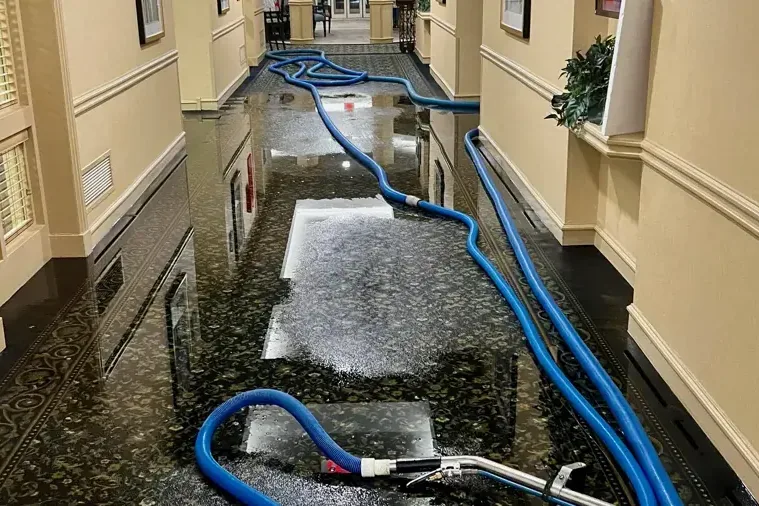
What every water extraction and removal job includes
Extraction comes first
Truck-mounted and portable extractors pull free water before any fan goes down, since lifting liquid water out is far faster than evaporating it.
Dried to IICRC S500
Air movers and LGR dehumidifiers are sized to the class of loss, and the equipment stays until readings sit within 2 to 4 points of a dry reference.
A claim file built on site
Moisture maps, daily psychrometric logs and timestamped photos taken before any demolition give the adjuster a clear record of the loss.
Valley houses, valley habits
Slab floors with copper underneath, attic air handlers and large floor plans decide where water hides, so the walkthrough checks each one.
What to do right now about water extraction and removal
- Stop the source. Close the valve or shutoff so no new water reaches the floor.
- Describe what is wet. Name the rooms, the source and any rented or shared spaces.
- Crew pumps and vacuums. Standing water is removed and wet pad is lifted from the floor.
- Readings set the plan. Meters decide what stays and where drying equipment goes.
What does water extraction and removal cost in Montclair, CA?
Water extraction in Montclair usually costs $350 to $1,200 for a spot job, $1,200 to $4,000 for several rooms and $4,000 to $9,000 for a whole floor, before any drying work that follows.
Spot extraction
- One room or less affected
- Wet vacuum work only
- Minimal material removal
Several rooms
- Pumps and wet vacuums
- Wet pad lifted and removed
- Moisture readings taken
Whole floor
- Large pumped volume
- Several rooms of materials
- Follow up drying needed
What the claim file holds
Ranges are typical, not a quote: the water category, square footage, material class and how fast drying started move the number most. Sudden and accidental water from a pipe, appliance or tank is often covered by a homeowner policy, while surface flooding usually needs a separate flood policy, so check your own policy.
The mitigation team builds the file an adjuster reads: a moisture map, daily psychrometric logs, timestamped photos taken before demolition, the category and class, and a line-item scope. For a closer range, run the water damage cost calculator.
How water extraction and removal is handled, step by step
Locate the water
Source and spread are mapped with meters
Remove standing water
Pumps first, then wet vacuums
Lift what cannot dry
Wet pad and soaked insulation go out
Hand off to drying
The equipment plan follows the readings
Extraction is the first real job on a wet property, and speed matters because water keeps moving into baseboards, drywall and the subfloor while it sits. In Montclair, where 45.2% of occupied homes are rented, the work often starts with a tenant, an owner and a property manager who each need to know what is wet.
Removing the water first
Pumps handle deeper water and wet vacuums finish thin layers on tile, wood and carpet. Wet carpet pad is typically discarded because it holds moisture long after the surface feels dry, while the carpet itself may be saved. The crew also lifts furniture legs onto blocks so stains and swelling do not start on the pieces left behind. Cabinet bases and baseboards are checked as well, since water wicks upward into them.
What a busy household needs
A short first note listing the rooms, the source and when the water was noticed helps the extraction crew begin in the right place. Households in Montclair averaged 3.56 people in 2020, so beds, desks and shelves often stand in the wet area and are worth listing too.
After the water is out
Once standing water is gone, walls, cabinets and floors are read with a moisture meter, and those readings decide the drying plan. A structural drying setup follows, and the readings continue until the materials return to normal levels.
Water extraction and removal across Montclair and nearby communities
Extraction crews work across Montclair, from the Monte Vista tract to the Narod area, for rentals, owned homes, small shops and offices that need standing water removed.
The same service nearby: water extraction and removal in Walnut, Pomona, Chino Hills.
Related water damage services in Montclair
Water Extraction and Removal questions, answered
Still dealing with it?
Standing water in a hallway, kitchen or garage keeps spreading until it is pumped out, so describe the damage and the crew will plan the extraction.
(888) 563-9619 Ask about a pump outWhat does water extraction include?
The crew pumps or vacuums standing water, lifts wet carpet pad and removes soaked materials that cannot dry, then reads the walls and floors with moisture meters before drying begins.
Can carpet be saved after a leak?
Often the carpet can be saved while the pad is replaced, when the water was clean and the carpet is lifted and dried promptly. Sewage or long soaking changes that, and the meter readings settle the question.
Who should be told first in a rental?
The tenant should tell the owner or property manager in writing and keep photos of the wet area. With 45.2% of occupied homes rented here, that written note keeps everyone on the same record.
Who handles a leak outside the building?
A leak in the street or at a hydrant is reported to the Monte Vista Water District, which supplies water to Montclair. The extraction crew handles water that has already entered the building.
How soon should extraction start?
As soon as it is safe, because water moves into drywall, cabinets and subfloors while it sits. Waiting longer raises the chance that materials must be removed instead of dried.
Water on the floor in Montclair?
Describe the rooms and the source, and the extraction crew plans pumps, vacuums and drying before it arrives.
(888) 563-9619Call the extraction crew