Water Extraction in Pomona, CA
Water that sits on a floor keeps spreading into pad, baseboards and drywall. The extraction crew pulls it out with pumps and wands, then hands a nearly clear room to the drying team.
(888) 563-9619Start pulling water off the floor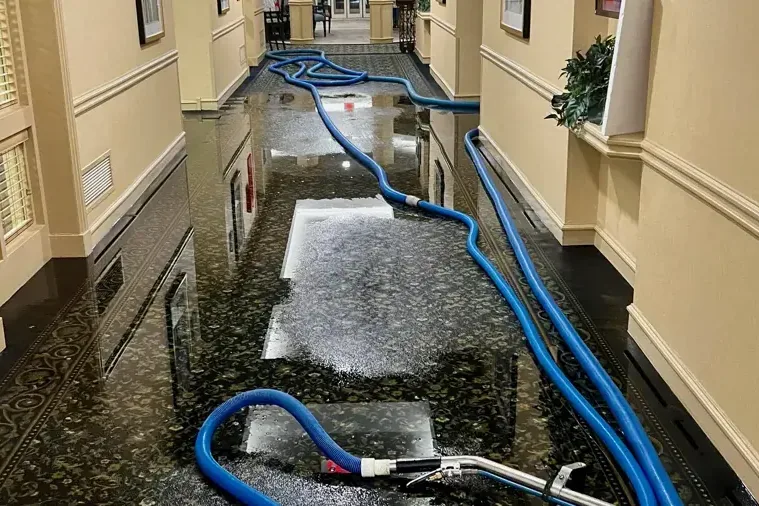
What every water extraction and removal job includes
Extraction comes first
Truck-mounted and portable extractors pull free water before any fan goes down, since lifting liquid water out is far faster than evaporating it.
Dried to IICRC S500
Air movers and LGR dehumidifiers are sized to the class of loss, and the equipment stays until readings sit within 2 to 4 points of a dry reference.
A claim file built on site
Moisture maps, daily psychrometric logs and timestamped photos taken before any demolition give the adjuster a clear record of the loss.
Valley houses, valley habits
Slab floors with copper underneath, attic air handlers and large floor plans decide where water hides, so the walkthrough checks each one.
What to do right now about water extraction and removal
- Trace the spread. Moisture readings show how far water traveled past the first wet spot.
- Remove surface water. Pumps and wands pull standing water, then a wet vacuum clears the rest.
- Lift ruined materials. Soaked pad and boards that cannot dry are cut out and bagged.
- Hand off to drying. Final readings let the drying team set its equipment.
What does water extraction and removal cost in Pomona, CA?
Extraction in Pomona usually costs $350 to $1,200 for a spot, $1,200 to $4,000 for several rooms and $4,000 to $9,000 for a whole floor. Floor type and water age shift the price.
Spot extraction
- One room corner or hallway
- Pump, wand and vacuum pass
- Short follow-up drying
Several rooms
- Pad lifted and often replaced
- Baseboards checked for wicking
- Drying equipment runs longer
Whole floor
- Every room on the level
- Flooring and drywall assessed
- Extended structural drying
What the claim file holds
Ranges are typical, not a quote: the water category, square footage, material class and how fast drying started move the number most. Sudden and accidental water from a pipe, appliance or tank is often covered by a homeowner policy, while surface flooding usually needs a separate flood policy, so check your own policy.
The mitigation team builds the file an adjuster reads: a moisture map, daily psychrometric logs, timestamped photos taken before demolition, the category and class, and a line-item scope. For a closer range, run the water damage cost calculator.
How water extraction and removal is handled, step by step
Source check
The crew shuts off or confirms the water source.
Pump out
Pumps and wands clear standing water.
Final pass
A wet vacuum finishes the surface.
Readings
Moisture checks set the drying plan.
Standing water is a race against the materials under it. Most of Pomona's 14.47 inches of yearly rain falls in winter, and February is the wettest month at 4.15 inches, so extraction calls here tend to follow the winter storms.
Why extraction goes first
Fans and dehumidifiers cannot work through a standing layer of water. The extraction crew confirms the source is off, then runs pumps, wands and a wet vacuum across carpet, tile and hardwood until the floor stops giving up water. Taking out the bulk by machine saves days of evaporation later and keeps the whole dry-out shorter.
What gets pulled out and what stays
Carpet often stays when the water was clean and the pad can be lifted, rinsed and dried. Soaked pad is usually cut out and bagged. Hardwood and laminate get weighted extraction tools or a floor drying mat so water leaves the boards without the floor cupping. Baseboards are checked for water that wicked behind them.
Storm calls and everyday spills
Not every extraction follows a storm. A failed hose, an overflowing tub or a pipe break leaves the same standing water, and the steps barely change from Phillips Ranch to the streets near downtown. The crew finds where the water went, removes it, then records what the walls and subfloor still hold before structural drying begins.
Water extraction and removal across Pomona and nearby communities
Extraction crews work across Pomona, including Downtown, Phillips Ranch, Spadra and the Lincoln Park Historic District, and every street between them, in ZIP codes 91766, 91767 and 91768.
The same service nearby: water extraction and removal in Walnut, Montclair, Glendora.
Related water damage services in Pomona
Water Extraction and Removal questions, answered
Still dealing with it?
Water still pooled on the floor? Describe the room and the extraction plan begins.
(888) 563-9619 Ask about a flooded roomHow soon does standing water need to come out?
As soon as it can be reached safely. Water keeps moving into carpet pad, baseboards and drywall for as long as it sits, so earlier extraction means fewer materials that have to be torn out.
Can carpet be saved after a flood?
Often, when the water was clean and the pad is lifted and dried. Carpet that sat in sewage or long-standing dirty water is usually discarded because cleaning cannot make it safe again.
Does extraction replace drying equipment?
No. Extraction removes the water a machine can pull. Moisture left in the subfloor, studs and drywall still needs air movers and dehumidifiers, so the two steps run back to back.
Do winter storms cause most extraction work here?
Winter brings the bulk of the year's rain, with February the wettest month, so storm calls climb then. Pipe failures, overflowing appliances and failed water heaters add standing water in every season.
What should be done before the crew gets there?
Turn off the water supply if the source is known, lift small items off wet floors and avoid walking through standing water near outlets. Leave the water itself to the extraction equipment.
Clear the floor before the subfloor soaks it up
Call now, any hour, and say what flooded the room so the right pumps and wands are loaded.
(888) 563-9619Send the pump crew